Showing posts with label biodiesel. Show all posts

Tuesday, October 6, 2009

Green Innovations for All Manner of Oils

I have been hearing all kinds of whisperings about the different oils available for a plethora of things from home heat to the oils we cook with so I thought I’d give a run down of some of the coolest innovations I have uncovered recently as well as some of the folks who provide said oils (if possible). Suffice to say this post is going to be fairly link intensive so feel free to come on back and read through anytime!

Avocado oil - home cooking oil (primarily). In a Vegan cookbook my Mom gifted to Matt and I, the author uses almost nothing but avocado oil for her dishes. I had never heard of it and was intrigued. Lo and behold there is an entire Wiki page dedicated to the stuff. Sounds yummy. Next time I am at the supermarket I will be looking for this oil, review to follow!

Algae oil - petroleum replacement. A leader in production of this revolutionary product is OriginOil. The process entails creation of algae (possible without impacting any ecosystems) and subsequent extraction of the oil left behind after the algae mixture is mixed with CO2, water (greywater is preferred) and minerals. The CO2 is dissolved, water hovers in the middle, biomass sinks and the useable oil rises to the top to be harvested. Without having to drill or chop down a plant. Cool.

Flax seed oil - linseed oil, many uses. I have made use of linseed oil as a furniture polish as it leaves a wonderful sheen and strong protective coat when applied in layers. The flax seed is commonly ground up and used in food products. This oil can be used by Raw food enthusiasts as it is obtained through a cold pressing method. This is linoleum (common flooring material) in its pure form. No matter what is done with the oil take care not to place any soaked rags in confined spaces as it is common for them to spontaneously combust.

Coconut oil - a million and one uses! Coconut oil comes in virgin, refined, hydrogenated and fractionated types. When reading the back of a detergent bottle, there are sometimes the words: “natural surfactant” lurking about. Nine out of ten times this natural ingredient is coconut oil. This versatile oil can also be used in cooking, bath and beauty products, petroleum replacements (especially as vehicle fuels & lubricants), for medicinal purposes and a myriad of other applications.

Bioheat oil - home heating oil. Bioheat oil is created when conventional home heating oil and clean burning biodiesel are combined. In a bold move here in my home state of Massachusetts, a mandate goes into effect January of 2010 that at minimum 2% biodiesel must be used in conjunction with all standard home heating oil. This number is low but the effort is high. As the biodiesel movement becomes more standard and homeowners find it is viable, 2% will skyrocket as the years go on; reducing emissions and increasing clean burning fuel sources nationwide.


Image courtesy Domk

Sunday, August 16, 2009

On the Move with NorthStar Moving Corporation

Almost all of us have done it, Matt and I personally joke we are professionals now, college kids are about to do this en mass - moving. Most of us think of moving as a hassle or a headache and many of us also understand the environmental impact this activity can have on the planet due to emissions alone, never mind the lifecycle of boxes or the trucks, and even Greenies may not be thinking of the impact the facility itself will have. So who do we turn to in this stressful time to ensure not only that we remain calm and cared for, but that our planetary impact is low? Well NorthStar Moving Corporation may drive bright red trucks but look closer and all you will see is Green!

Based out of Los Angeles, California, NorthStar Moving is in a prime location but do not let the Southern California address fool you! Although their primary geographic focus is moving folks from the Los Angeles area, they are looking to expand their service in order to move anyone, anywhere. Oh, and they are doing it all in trucks that run on biodiesel.

After the conversion, and once it became clear that the old trucks were harmful to the planet, yet impossible to convert because of their current age and wear, NorthStar Moving hooked up with E-Cycle Environmental to break down and recycle the oldest trucks. E-Cycle also assists by offering a more eco friendly option for folks who are moving and getting rid of bulky, potentially harmful items (such as televisions, computers, etc).


Additionally all the new trucks were outfitted with lift gates that run on battery power as opposed to the engine. Emissions can be further reduced as the truck does not need to be running constantly during a move, the lift will operate while the truck is off. This is a very cool innovation and one I believe is exclusive to NorthStar as I can not find another company that indicates they do this yet.

Of course the awesomeness does not stop at the trucks and their fuel source.

All of the boxes the company sells are created from recycled materials but get this, they will also grant a 25% discount if you bring your boxes back to be recycled. Then the next person can re-purchase those boxes also at a 25% discount. Taking advantage of both moving boxes are sold at a 50% of rate, sweet!

The storage facilities utilize wooden storage compartments (made from recycled materials!) that are stacked in order to save on need for space as well as materials and the warehouses take advantage of natural light (through use of skylights) which helps to save on electricity as well.

All this is well and good but without strong customer service and attention to the client’s needs even the most eco-friendly company will not last very long. NorthStar has been in business for about 15 years and they not only offer a basic door to door moving service but also literal Red Carpet, luxury moving service. These folks have moved everyone from budget conscious college students to Hollywood heavy hitters like Angelina Jolie, Chuck Norris and Eva Longoria.

Not to mention their work with Hollywood Green Team, Sustainable LA** and the pre Oscar Green Carpet party this year. These services truly set them way apart from any other Green moving company out there never mind the fact that they treat everyone the same no matter what their moving budget is.

I spoke with a company representative to see what types of offerings they have at this time and for those in need of a storage solution now is an excellent time to take advantage of NorthStar’s services because in addition to their deal of $49.00 per month for a 5' x 7' x 8' high unit, you are also going to get the first month free. Yippie!

I am completely impressed with the company model that NorthStar is structuring here and like I said, since Matt and I move more often than the average family it is pretty safe to say I will be utilizing these services at some point in the not too distant future myself.

With such an innovative approach and strong planetary focus NorthStar is well deserving of a Four Leaf Rating!


Keep up the amazing work!
♥love♥


** The Downtown Film Festival runs from August 12 - 22 primarily located at the corner of 7th & Figueroa. Sustainable LA is a full day of Green awesomeness that includes speakers, films, parties and advice (all free!) and it takes place on Thursday August 20 from 10AM - 11PM at the Ernst & Young Plaza. If you’re in the area I highly recommend checking it out!

Thursday, August 6, 2009

Whatchu Talkin’ ‘Bout Part II - Bio-plastic And Other New Eco Terms

Over the past couple reviews I have used the word ‘bio-plastic’ and it suddenly hit me that it has been quite a long while since I put out the first Green Terms post. In an effort to keep everyone up on the latest and greatest terminology, so you can shop and explore like the savvy Greenies I know you all are, here is part II in no particular order.

Bio-plastic: Where most common plastic (such as polyester or water bottles) is created from fossil fuel, known as petroleum, and turned into PET (polyethylene terephthalate), bio-plastic is different. Commonly created from plant based resources (such as corn starch) bio-plastic is as durable as its PET counterpart however it is less harmful to the environment as it can be composted in commercial facilities and will break down there in about 90 days. It produces far less emission to create as well as in its breakdown so the overall lifecycle impact is far less than petroleum.

Lifecycle: Sometimes referred to as ‘cradle to grave’ a life cycle assessment measures environmental impact of an item or service for its entire life (upcycling, recycling and reusing all help extend the lifecycle of an item ensuring less new is created).

Greenwashing: Greening up our lives has moved into the forefront of most people’s minds as more and more people are becoming aware of the very real impact we as humans are having on the planet and its resources. Many companies and organizations have decided to use this as a way to cleverly market their products regardless of the actual environmental impact. When a company touts their products as Green (or eludes to an illusion of such), yet the overall environmental impact is negative, Greenwashing has occurred. Diligence in research and review will make us savvy consumers in the realm of Green products and services!

Organic: Commonly confused with the word natural, organic methods and practices can be applied to all manner of items from food to clothing. Organic food is free of all chemical based products (pesticides, growth hormones, additives, etc). Organic clothing is created from natural fibers grown using organic methods (cotton, bamboo, hemp, soy, wool). Additional items such as baby supplies (lotions, toys) and cosmetics are offered in organic versions as well.

Community Supported Agriculture (CSA): From Wikipedia - “is a socio-economic model of agriculture and food distribution. A CSA consists of a community of individuals who pledge support to a farm operation so that the farmland becomes the community's farm, with the growers and consumers providing mutual support and sharing the risks and benefits of food production. CSA’s focus is usually on a system of weekly delivery or pick-up of vegetables and fruit in a vegetable box scheme, sometimes dairy products and meat”. Plans in my area can run from $300 - $1200 depending on the items acquired and length of membership (many are seasonal) and the items are chosen by the farm for current availability in the crop.

Socially Conscious: A basic awareness and open eye to the conditions of the entire human race. Many people will define it differently but I believe it is both a global as well as local consciousness to provide as much as possible to all people. This can be achieved through monetary means, volunteering, product, service or trade.

Bio-diesel: Fuel for a vehicle (or other motorized machine), as well as home heating units, as sourced from resources other than petroleum but typically vegetable based (such as corn based ethanol).

Carbon offset: A literal counterbalance to the greenhouse gasses (CO2) emitted by any individual. Each carbon offset “credit” is allegedly equivalent to one metric ton of CO2 being removed from the atmosphere. For example, planting a tree or investing in a wind farm are considered an offset. The term and practice is controversial as some feel it encourages a lack of awareness to current practice as the bad behaviors can simply be “bought off”.

Part I of Whatchu Talkin’ ‘Bout includes these eco terms:

environment
green
recycle
upcycle
eco
repurpose
earth day
solar
passive solar
photovoltaic panels
wind turbine
compost
emission
sustainable
renewable resource
global warming
climate change
carbon footprint

What are some of the terms you would like to see defined? Let me know in the comments section!

Monday, December 29, 2008

Super High MPG Cars

When I asked Matt if he was willing to help me gain some inspiration for the next Green Leaf blog posting he agreed to do a little poking around. He found inspiration alright and it led him to research some of the cars that Europe has available which get high miles per gallon and how those cars compare to the ones we have here in the United States. For the next few hours all I heard was furiously clicking keys. Here is what he found.

It may come as a surprise to some that we here in the US are not offered the latest and greatest technology when it comes to high MPG cars. In fact, the highest MPG car available in the US, the Toyota Prius with an average of 46 MPG (per EPA guide), would only fall in the middle of the pack in the UK. Sadly our thirst for larger, more performance oriented cars along with self-defeating EPA regulations have kept the highest MPG cars from ever reaching our shores. The high MPG cars that do reach our shores have features and performance tuning that reduce the MPG by 30% or more from their European models. Additionally, gasoline sold in Europe carries a higher octane than in the US. 95 is Regular in the UK vs. 87 in the US, and Premium is 99 vs. 93 in the US. The UK model of the Toyota Prius gets 65.7 MPG combined on 95 octane.

In Europe, the primary solution to the MPG problem is diesel. The advantages of diesel are tough to argue. It is a technology that has been tested and refined for over 100 years. Diesel fuel has more stored energy per gallon than gasoline, therefore is more efficient at powering an automobile. The engines need to be built stronger to withstand the additional energy, so they tend to be more durable, too. The down side is that diesel fuel is more expensive, and until recently, diesel ran much dirtier than gasoline. The dirty factor is why the EPA put restrictions on diesels in the US. Oh, how times have changed, though. Most diesels now run as clean or cleaner than comparable gasoline engines, and almost all of them release substantially less CO2 than gasoline. Also, don’t forget that biodiesel is a much more viable fuel than ethanol, and is commercially available now.

Here is a quick glance at a few diesels now selling in the UK:

Volkswagen Polo Bluemotion 1.4 combined MPG 74.3
BMW 118d combined MPG 62.8
MINI Cooper D combined MPG 72.4

For those of you who thought the Detroit Big 3 couldn’t or wouldn’t build a fuel efficient car, you are wrong!

Ford Focus 1.6 TDCi ECOnetic combined MPG 65.6

So, you ask….why can’t I get these cars here in the states? There are a few reasons. The EPA had clean air restrictions for particulates in place for many years that kept diesels from hitting our shores. Not that I advocate particulate matter in our air, but it’s a far cry from the greenhouse gasses that gasoline engines pour into our environment. New diesel engines have filters for these particulates, and Ultra Low Sulfur Diesel fuel has eliminated much of the remainder of the pollution, which is why there will likely be more diesel choices on the market in the years to come. The second reason is consumer demand. If these cars are going to be sold here, we as consumers need to let our auto dealers know that we want them. Americans have never had a love affair with diesels due their smelly reputation. That reputation should dissolve with the clouds of black smoke that used follow those old diesels around.

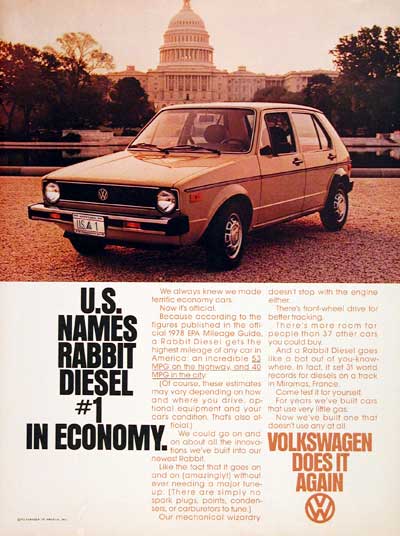
On a personal note, I am a former owner of a 1984 VW Rabbit diesel. Because of the relative simplicity of the engine, I was able to get over 300,000 miles on the odometer without a major engine problem. (Of course there were other little problems, but nothing major…) Even at 300K, I was getting over 45 MPG average. I wasn’t winning any drag races, but I cruised past an awful lot of gas stations without stopping.